


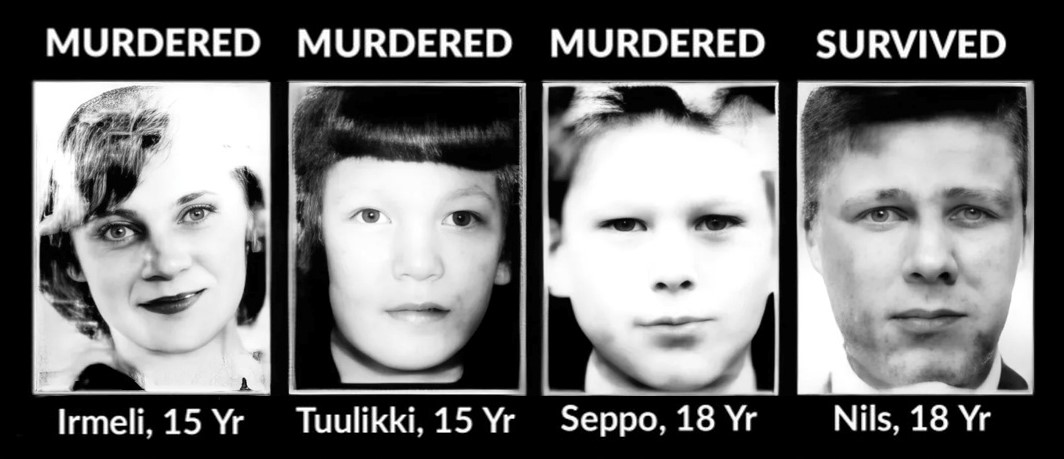
On the night of June 4, 1960, four teenagers—Maila Irmeli Björklund, Anja Tuulikki Mäki, Seppo Antero Boisman, and Nils Wilhelm Gustafsson—pitched a tent on the serene shores of Lake Bodom in Finland for what was meant to be an overnight camping trip. But the peaceful night turned into a nightmarish mystery that continues to haunt the country. By morning, three of the teenagers were dead, their bodies brutally mutilated. The lone survivor, Nils Gustafsson, was found severely injured, and more than six decades later, the mystery of who committed these murders still lingers.
The Gruesome Discovery
On June 5, 1960, a birdwatcher, Esko Oiva Johansson, stumbled upon a chaotic and grisly scene. The teenagers’ tent had been savagely slashed from the outside. Inside were the lifeless bodies of 15-year-old girls Maila and Anja, along with 18-year-old Seppo. All three had been stabbed repeatedly and struck with a blunt object. Blood soaked the tent, and the violence of the attack was staggering. Nils Gustafsson, the only survivor, was found lying outside the tent, unconscious, with a broken jaw, bruises, and a concussion.
Though Nils had survived, his injuries were substantial, leaving him dazed and his recollection fragmented. He would later claim that he could not remember the attack, fueling speculation that his trauma had left him unable to identify the killer—or worse, that he had something to hide.
An Investigation Clouded by Errors
As is tragically common in cases from this era, the investigation into the Lake Bodom murders was riddled with mistakes. Police arrived at the scene and, by modern standards, mishandled crucial evidence. Passersby and curious locals were allowed to wander through the site, potentially contaminating it. Key items, including some of the victims’ clothing, were missing, and the murder weapons—a knife and a blunt object—were never found.
Early in the investigation, Nils Gustafsson was treated more as a victim than a suspect. He was hospitalized for his injuries, and though some of his statements were inconsistent, they were attributed to the trauma of the event. Despite extensive searches and questioning of nearby witnesses, police were unable to come up with a concrete suspect. One witness reported seeing a mysterious blonde man walking away from the campsite around the time of the murders, but this lead never panned out.
A Decades-Old Cold Case Reopened
The case remained cold for over 40 years until, in 2004, Finnish police reopened the investigation. This time, Nils Gustafsson found himself at the center of the inquiry—not as a victim but as the prime suspect. Investigators believed that a violent altercation between Gustafsson and Seppo Boisman had escalated into a full-blown massacre, with Gustafsson allegedly attacking his companions in a fit of jealous rage, possibly fueled by alcohol. The theory was that after killing his friends, Gustafsson staged his own injuries to appear as though he had been a victim, too.
Despite this dramatic accusation, many doubted Gustafsson’s guilt. His injuries were extensive, and it seemed improbable that he could have inflicted such trauma on himself. In 2005, after a high-profile trial, Gustafsson was acquitted due to lack of evidence. Though the trial reignited public interest, it also highlighted the complexities and frustrations of the case, as no new suspects emerged, and the mystery remained unresolved.
Theories Abound
With so little hard evidence, the Lake Bodom murders have spawned a host of theories—some more plausible than others. Over the years, investigators, journalists, and amateur sleuths alike have attempted to unravel the truth behind the killings.
- The Kiosk Keeper: A local kiosk worker was one of the last people to see the teenagers alive. He had a reputation for being argumentative and was briefly considered a suspect. However, no substantial evidence tied him to the crime, and he was soon dismissed as a serious suspect.
- Pentti Soininen: This violent criminal, who was imprisoned at the time of the investigation, reportedly confessed to the murders before his death. However, his confession was inconsistent, and some of the details didn’t align with the facts of the case. Additionally, Soininen had a documented history of mental illness, making it difficult to trust his account.
- The German Spy Theory: A particularly compelling theory suggests that a former German soldier, who had been hiding in Finland after World War II, may have been responsible. It’s believed that this man, living under an assumed identity, was in the vicinity at the time of the murders. Some speculate that he could have been a fugitive or was involved in espionage activities, adding a cloak-and-dagger element to the case. This theory gained traction over the years but ultimately faded as investigators failed to conclusively link him to the crime.
- Random Attack by an Unknown Assailant: Others believe the murders were the result of a random act of violence. Some theorize that a mentally unstable individual or a passing killer stumbled upon the campsite and committed the heinous acts without any personal motive. The randomness of the murders—especially given the isolated location and the brutality of the attack—fuels this theory. However, the killer’s ability to avoid capture for so long also raises questions.
The Legacy of the Lake Bodom Murders
To this day, the Lake Bodom murders loom large in the Finnish national consciousness. The case is more than just an unsolved crime—it’s a dark, tragic chapter that refuses to close. Over the years, it has inspired countless books, films, and even horror stories, casting a long shadow over Lake Bodom itself. A place once known for its natural beauty is now remembered as the scene of a horrifying, violent act that defied explanation.
For the families of the victims, the lack of closure is devastating. Despite new forensic methods and technology, the Lake Bodom case remains cold, with each passing year making it less likely that the truth will ever be fully uncovered. And yet, the case continues to attract attention from true crime enthusiasts, amateur detectives, and the Finnish public, all hoping that one day, the mystery will finally be solved.
What Do You Think?
Theories about the Lake Bodom murders abound, and the case’s notoriety has only fueled more speculation. Do you think Nils Gustafsson was the killer, or was he just another victim? Was it a random, unprovoked attack? Or does the German spy theory hold the key to unraveling this mystery?
Share your thoughts in the comments below—what’s your theory? If you think you’ve found a clue or angle that others have missed, let’s hear it! After all, this cold case might still have secrets waiting to be uncovered.
This case is quite harrowing. I appreciate your willingness to read these cases and follow along with me as I research and report. Hug your family tonight and take great care the next time you go camping.
xoxo
-S
Sources:
- Police reports from 1960 and trial documents from Nils Gustafsson’s acquittal in 2005.
- Finnish news archives and investigative reports from various media outlets.
- Speculative theories from true crime books and articles surrounding the Lake Bodom murders.
As an amateur true crime writer, I strive to provide accurate and well-researched information. However, please be aware that I am not a professional investigator or journalist, and my work is based on available sources and my understanding of the case. There may be inaccuracies or incomplete details in my posts. I encourage readers to seek out additional sources and verify information from official and professional channels. Thank you for your understanding and support.
 Diet Coke and Hair-Spray